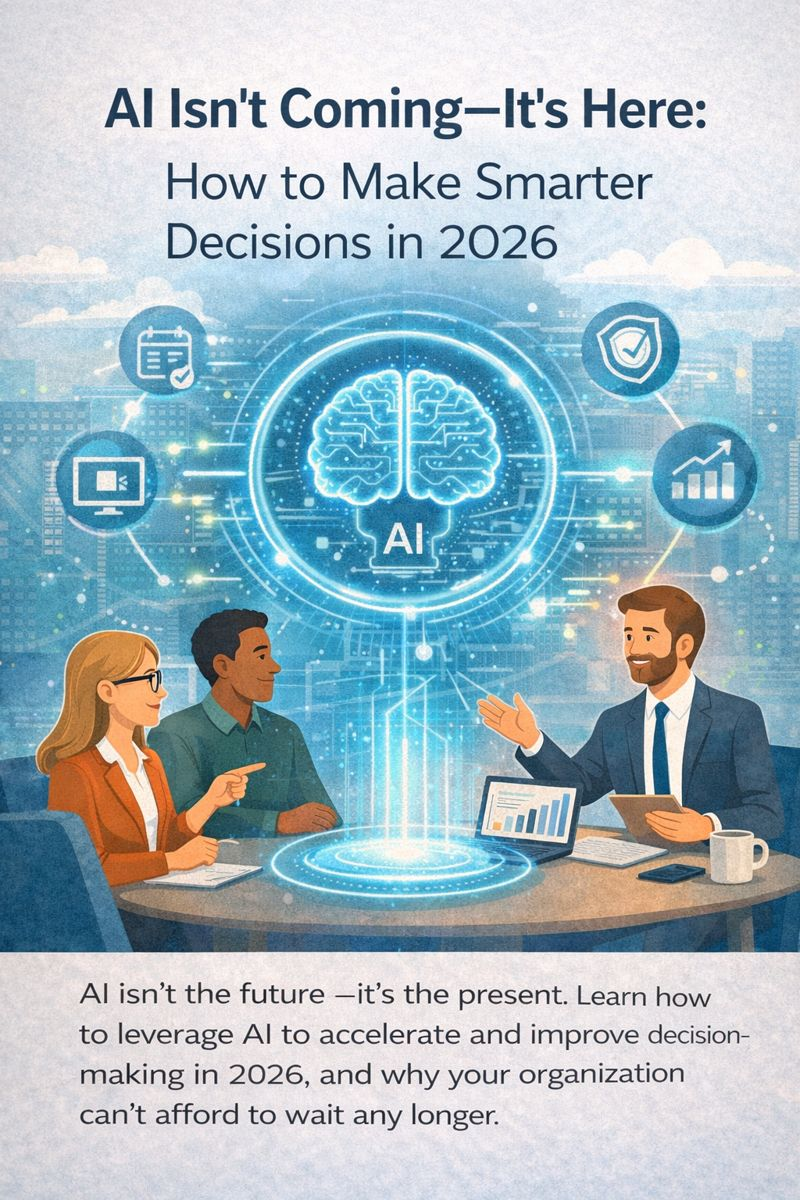
Every business leader is asking the same question:
“How do we use AI?”
It’s the wrong question.
The better question is:
“How do we use AI better than our competitors?”
AI is quickly becoming like email, cloud computing, or the internet. Eventually, nearly every company will have access to similar AI models and tools. Simply having AI won’t create a competitive advantage.
What will?
The companies that rethink how work gets done.
The firms pulling ahead aren’t asking employees to “use AI when you can.” They’re redesigning workflows, eliminating repetitive tasks, shortening decision cycles, and giving people more time to solve customer problems.
That’s where the real return comes from.
I’ve seen organizations save hours generating proposals, documenting meetings, analyzing requirements, and creating software. Those time savings are valuable—but only if they’re reinvested in activities that create more value for customers.
Otherwise, AI simply helps you do the same work a little faster.
The winners will be the organizations that pair AI with capable people, strong processes, and a culture of continuous improvement.
Technology alone has never been enough.
Competitive advantage comes from how people use it.
Enterprise leaders who are still talking about the future of AI are already behind. In 2026, AI isn’t a trend to watch—it’s a capability to master. The real conversation now is: how do we embed it into daily decision-making to move faster, smarter, and with less guesswork?
Decision Velocity is the New Competitive Advantage
CIOs and CTOs are under pressure to deliver results faster. But the winners aren’t just accelerating decisions—they’re improving them. AI is giving leaders the ability to process complex datasets, model outcomes, and get clarity on risk before the first move is made.
At Intertech, we’ve seen this firsthand. Whether it’s fine-tuning product development roadmaps or optimizing operational workflows, AI-driven insights are changing how decisions get made—and who gets to make them.
Practical AI, Not Hype
Forget the moonshot scenarios. The most valuable AI tools in 2026 are the ones enhancing real workflows. Leaders are deploying models to:
Prioritize backlogs based on customer impact
Improve forecasting with historical and real-time data
Flag inefficiencies or security risks before they become problems
And thanks to platforms like Intertech’s UnifiAI, our clients are doing this with tools purpose-built for software development. From planning to deployment, we’re integrating AI to support better decision-making without disrupting team flow.
The Human-AI Partnership
AI isn’t replacing leadership—it’s elevating it. The smartest companies are training their teams to ask better questions, interpret AI-generated recommendations, and use those insights as a launchpad for innovation. The future belongs to those who know how to collaborate with AI, not compete with it.
Ready or Not, the Shift is Here
If your organization still treats AI as a pilot project or fringe initiative, now’s the time to course-correct. Set clear business goals. Train your team. Choose tools that integrate with your workflows. And remember: in 2026, smart decisions aren’t just human-powered—they’re AI-enabled.

Staying on top means staying self-aware. As we enter 2026, the challenges facing leaders—especially those in tech and consulting—are evolving fast. AI is reshaping how we deliver value, hybrid work is no longer novel, and clients are expecting more transparency and results than ever.
Below are seven leadership missteps to watch out for this year—along with a few ideas on how to avoid them.
1. Relying on Gut Over Data
In 2026, instinct is no longer enough. With AI-driven insights, customer analytics, and data-rich environments, leaders who continue to make key decisions based on hunches risk falling behind. The leaders who win will be the ones who blend their experience with real-time insights.
Tip: Tools like Intertech’s UnifiAI can help make sense of project data, customer behavior, and risk signals across your ecosystem.
2. Ignoring AI Literacy
AI is no longer optional. Leaders don’t need to be engineers, but they must understand how AI works, where it fits, and how it impacts both their team’s output and their customers’ expectations.
Tip: Invest in AI training for yourself and your team. Even a 60-minute session on prompt engineering can pay off fast.
3. Micromanaging a Hybrid Workforce
The days of “management by walking around” are over. In 2026, micromanaging remote or hybrid teams erodes trust, kills morale, and signals that you don’t trust your people.
What to do instead: Set clear goals, track outcomes, and check in with curiosity, not control.
4. Saying Yes to Everything
This one hasn’t changed in decades, but it’s even more dangerous today. Saying yes to every meeting, project, or proposal spreads your team thin and leads to burnout—or worse, underdelivery.
Smart leaders in 2026 are ruthless about priorities. If it doesn’t move a key needle, it’s a no.
5. Skipping Structured Communication
In the age of Slack and “quick Zooms,” communication can become reactive and chaotic. That’s why structured communication—like daily huddles, monthly all-hands, and weekly project updates—is more valuable than ever.
At Intertech, our daily huddle keeps everyone aligned and accountable in under 15 minutes. It’s a staple of how we operate and scale clarity.
6. Overlooking Culture During Growth
Growth is exciting—but it also hides cultural cracks. When the pipeline is full and the team is growing fast, it’s easy to forget the things that made your culture great in the first place.
Remember: Culture doesn’t scale on autopilot. Protect it, promote it, and hire people who fit and elevate it.
7. Failing to Communicate the “Why”
Teams want more than tasks—they want meaning. Leaders who don’t tie projects to purpose will lose the hearts and minds of their best people.
Tie each initiative back to how it serves the customer, supports the team, or moves the mission forward. Especially with younger team members, the “why” matters more than ever.
Final Thought
Leadership in 2026 isn’t about being perfect—it’s about being present, intentional, and adaptable. The mistakes above aren’t new, but the stakes are higher. If you can spot them early and course-correct, you’ll set your team—and yourself—up for a strong year.
2026 is the year enterprise tech strategies go from experimental to essential. CIOs are setting clearer expectations, cutting through buzzwords, and demanding solutions that actually move the business forward. It’s not about trying everything—it’s about doing the right things well. Here’s what we’re seeing CIOs prioritize this year, based on what they’re asking for in our conversations at Intertech.
1. AI That Actually Delivers Value
The GenAI gold rush has matured. In 2026, CIOs aren’t exploring—they’re implementing. They want AI models that connect to their data, automate real tasks, and create measurable outcomes. At Intertech, we’ve seen demand surge for integrating AI directly into software development workflows—not as a bolt-on, but as a core capability. That’s exactly why we created UnifiAI—to help teams embed generative AI into the dev process itself, from architecture and design to deployment and optimization.
2. Legacy Tech: Simplify or Sunset
CIOs are done paying for bloated, redundant systems. The mandate this year is clean architecture, consolidated tooling, and platforms that scale without dragging down innovation. We’re working with several clients to rationalize their software ecosystems—sunsetting old apps and refactoring others—because leaner tech stacks aren’t just cheaper. They’re more resilient, more secure, and easier to evolve.
3. Security Is the New Differentiator
Cybersecurity isn’t just IT’s problem anymore. Boards and regulators are watching closely, and smart CIOs are investing in “secure by design” practices from day one. For Intertech clients in healthcare, finance, and other regulated industries, this has meant proactively baking compliance and threat mitigation into every project. Trust is now a feature—and it better be included at launch.
4. Outcomes Over Output
The days of measuring value by hours worked are fading. What clients really want is impact. Did we help users move faster? Did support calls drop? Did we help unlock new revenue? These are the metrics that matter. That’s why we always define success metrics early in every engagement—and revisit them constantly. It keeps us and our clients aligned on what actually moves the needle.
5. No Room for B-Teams
CIOs are being blunt in 2026: they don’t want to pay for learning curves, fluff, or consultants who can’t handle ambiguity. They want talent that’s smart, experienced, and collaborative. At Intertech, we hire for technical strength, yes—but also for emotional intelligence, curiosity, and the ability to operate as a true consulting partner. That’s what makes our teams different—and why so many clients keep coming back.
Why Lifelong Learning Is a Must in a World of AI, Agile, and Rapid Tech Shifts
In technology, the only constant is change—and it’s moving faster than ever. From AI breakthroughs to the rise of low-code/no-code platforms and the continual evolution of cloud-native development, the software world reinvents itself at lightning speed. If your team—or your consulting partner—isn’t learning, it’s not just treading water. It’s falling behind.
At Intertech, we believe staying current isn’t a luxury—it’s a responsibility. That’s why we’ve embedded continuous learning into the fabric of our culture.
1. The Ground Is Always Shifting
Think back just a couple of years. LLMs weren’t part of mainstream development. Now, platforms like ChatGPT, GitHub Copilot, and dozens of API-integrated AI tools are changing how we write, debug, and even conceptualize code.
It’s no longer enough to be great at one stack. Developers—and the firms they work with—must be nimble, curious, and ready to evolve.
2. Internal Training: Built-In, Not Bolted On
At Intertech, we’ve institutionalized growth. Our internal training programs ensure developers stay sharp with new languages, frameworks, security protocols, and architecture patterns. It’s not just about attending a one-off workshop. It’s about building a learning mindset.
From live classes to asynchronous resources, we empower team members to explore new tech on their own schedule—without sacrificing project delivery.
3. AI Isn’t a Threat. It’s a Tool.
A lot of developers worry AI is coming for their jobs. We see it differently.
AI is the new assistant in your IDE. It helps accelerate routine work, improve accuracy, and reduce the mental load of boilerplate tasks. But to truly benefit from it, developers need to know how to work with AI—and when not to.
That’s why we offer hands-on AI workshops, use prompt engineering internally, and bake AI capabilities into our project lifecycle through our UnifiAI offering. We’re not just learning AI. We’re teaching our clients how to wield it wisely.
4. Learning Is the Ultimate Competitive Edge
Whether it’s working with clients in new industries, migrating systems to the cloud, or building mobile-first experiences, learning fuels innovation. It allows us to anticipate challenges, guide our clients proactively, and avoid the stagnation that kills great companies.
Final Thought
There are no finish lines in technology. There’s only forward. At Intertech, we’ve made the choice to lean into the future—through training, tools, and talent development.
Because if you’re not learning, you’re not just falling behind… you’re making room for someone else who is.