In today’s talent market, many companies feel pressure to hire quickly.
That’s often a mistake.
A bad hire doesn’t just cost recruiting fees. It costs productivity, morale, customer relationships, and management attention.
The best organizations I’ve seen are patient. They know that waiting another month for the right person is almost always less expensive than spending a year managing the wrong one.
AI can screen resumes faster than ever. It can summarize interviews, compare candidates, and even identify potential skills gaps.
But AI can’t tell you whether someone shares your values.
Culture still matters.
Skills can be developed.
Character is much harder to teach.
The companies that win over the long run aren’t simply filling positions.
At Intertech, we’ve made a conscious shift in how we hire. While technical skills still matter, they’re no longer enough. The how behind the what—how a consultant thinks, adapts, and leads—is the true differentiator.
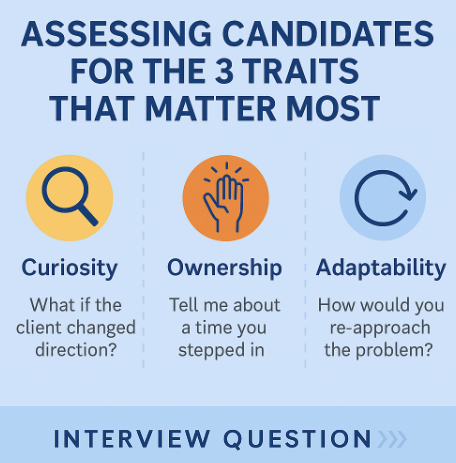
So how do we identify candidates who demonstrate curiosity, ownership, and adaptability? Here’s a look under the hood.
1. Curiosity
Look for the why-askers.
Interview Signal: We ask candidates to walk through a complex past project and pause halfway through. Then we throw them a twist—“What if the client had changed direction at this point?” or “What if a key assumption was wrong?”
What we’re watching for: Do they instinctively ask clarifying questions before answering? Do they seek to understand the business context or user goals? Curious minds don’t rush—they explore.
2. Ownership
Listen for stories where they took the wheel.
Interview Signal: We prompt candidates with this: “Tell me about a time when something went wrong and it wasn’t technically your fault, but you stepped in anyway.”
What we’re watching for: Do they shift blame or step up? Ownership doesn’t mean perfection—it means being accountable when it counts.
3. Adaptability
Throw them a curveball—on purpose.
Interview Signal: We often introduce a challenge mid-interview: “Let’s imagine your tech stack suddenly changed. How would you re-approach the problem?”
What we’re watching for: Are they flustered or open-minded? Do they pivot with poise or dig in defensively?
Bonus: We Talk Less, Listen More
Our interviews are structured to minimize talking and maximize listening. When candidates tell real, unscripted stories—especially about failures or pivots—that’s where the gold lives.
Why This Approach Works
When clients choose Intertech, they’re trusting us with big goals and big expectations. By hiring consultants who are naturally curious, take ownership, and adapt quickly, we stack the deck in everyone’s favor—ours, theirs, and yours.
We are hiring. Getting the right people is vital, obviously, to building a great team.
Building a great team starts with finding great people. Top firms spend an excessive amount of time recruiting.
One worldwide executive recruiting firm, Egon Zehnder International, conducts between 25 and 40 interviews per hire! Most of us don’t have the time or resources to put job candidates through such a rigorous recruiting process. However, we can take the time to check out a potential new employee thoroughly before asking him or her to join our team. If you’re wowed by someone’s technical prowess but concerned about his or her honesty or attitude, don’t risk it. When we have justified hiring someone—usually in response to a hefty workload—the person may have provided short-term relief but did not work out in the long term.
We have an eight-step process. An essential step in our approach uses an interview from the book Top Grading. Here’s a link to that interview.
Here are a couple of questions around coworker trust found on an engagement survey:
To help the leadership team understand how each of us are “wired”, we’ve all taken a personality assessment and created a cheat sheet which identifies the core ways we want to work with one another.
To create an environment of trust, as leaders, we need to let our team members know it’s O.K. to make mistakes. To create trust, we need to know each other as people. To do this, there should be a corporate calendar with scheduled business and social events.