Last month, I delivered a conference keynote. My talk was on engagement. For the 400+ attendees, I started by sharing what engagement means and finished with the eight areas of engagement and shared specific, actionable ideas to increase engagement.
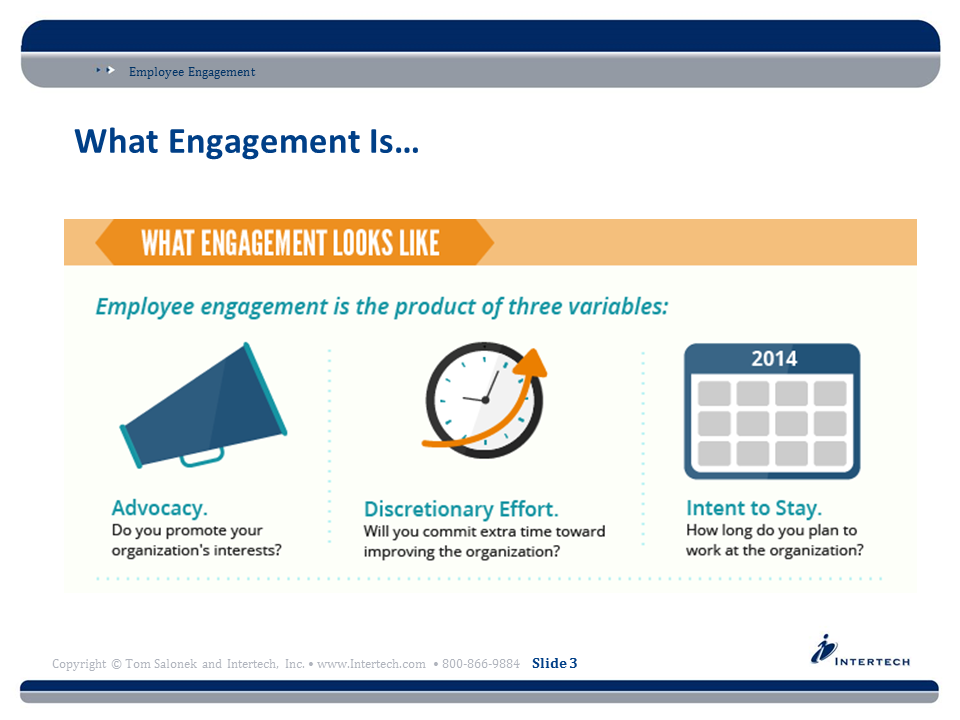
Employee engagement results in a few major things… employees who advocate and promote your organization, who do more than the job requires, and who stay.
When you see the “Best” or “Great” places to work lists in magazines or newspapers, they are based on engagement. Engagement surveys are measured by:
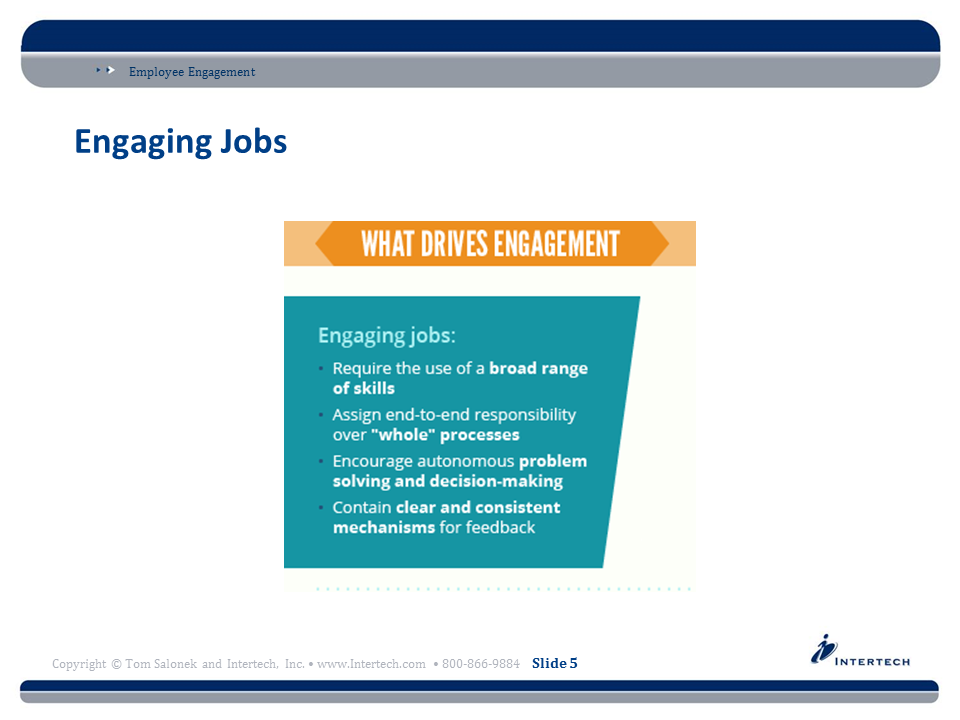
For an engaging job, this is what employees look for:
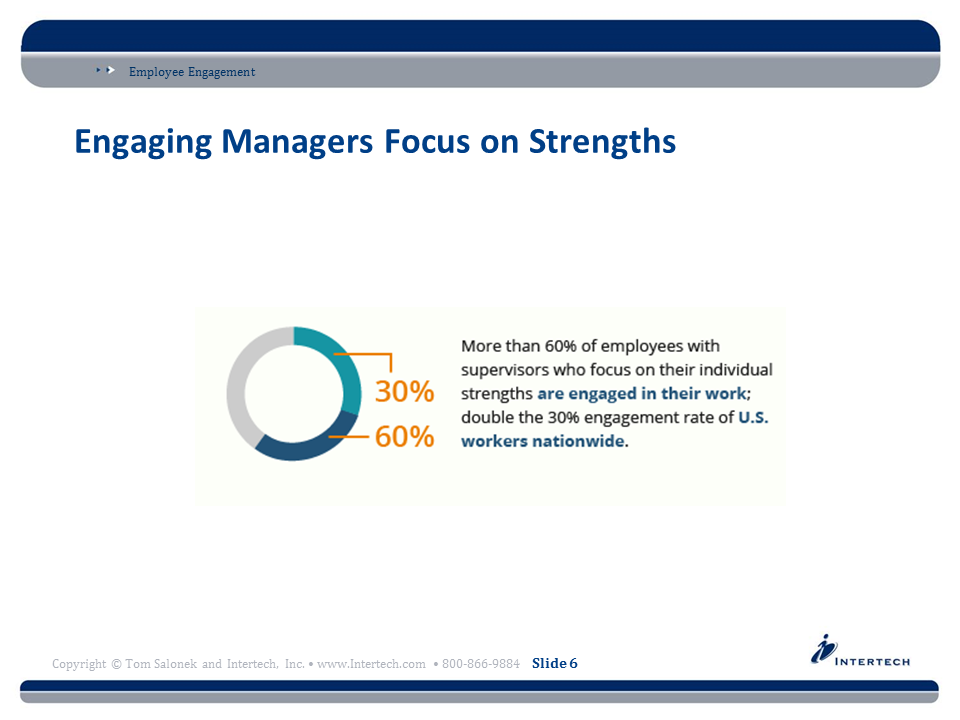
For a manager that drives high engagement, they don’t focus on weakness:
Engagement results in more productivity, profit, safety and less absenteeism:
Minnesota’s low temperatures and high taxes don’t make our state the easiest place to do business. Yet, our world-class workforce has made Minnesota a hub for innovation and economic growth. While I think we can and should do more to address other barriers to growth (at least the tax climate), we should start by preserving our biggest advantage—the quality of our people—which is threatened by rhetoric and policies that discourage international students from attending our colleges and universities.
The fact is nearly 70% of Twin Cities college graduates stay in the metropolitan area after graduation. As our current population continues to age, Minnesota businesses need access to talented people from around the world to keep pace.
Unfortunately, instead of looking for ways to attract the world’s best and brightest, the president obsesses about building a wall along the U.S.-Mexico border to keep out immigrants. It’s not surprising that many top foreign-born students are choosing to skip the U.S. of their own accord—with negative consequences for our economy, particularly our engineering and technology sectors. I’m referring to international students at U.S. colleges and universities who used to come here in record numbers to study STEM subjects.
In 2018, the University of Minnesota-Twin Cities ranked 21st of all leading institutions in the country hosting international students, with 7,212 international students. That number has decreased to 5,500 international students today. This distressing higher education trend is happening nationwide.
Why are the world’s brightest students skipping the U.S.?
“Many schools attributed the trend to problems with student visa delays and denials, as well as the U.S. social and political climate and student decisions to enroll outside the United States,” reported the Washington Post (11/13/18). With some education leaders noting, “Trump’s advocacy of immigration restrictions, travel bans and a U.S.-Mexico border wall is not helping the nation compete for academic talent in the global market.”
As foreign-born students say “no thanks” to what they perceive as a hostile United States, many are saying “yes” to higher education institutions in Canada and Australia. Their gain is our loss.
These are deeply disturbing trends to owners of IT consulting firms like me. We compete on a global basis and losing access to some of the world’s most talented science and technology students and professionals is a major blow.
And you should be worried too. Not only do these foreign-born students help grow the U.S. IT industry—IT workers represent about 2.9 percent of the U.S. workforce says the U.S. Census Bureau—but when they stay and start new businesses they create good jobs for people born in the U.S.
There’s another worrisome side effect of this growing trend: the loss of millions of dollars in tuition payments at American colleges and universities, including our own U of M. Since foreign-born students pay higher rates than U.S. students, their tuition dollars are vital to keeping costs lower for students here. If current trends continue, the next state budget might need to include funding support for struggling state colleges and universities.
Leaders in Washington appear to live in a U.S.-centric bubble these days, but here in Minnesota (and the rest of the country) it’s one highly competitive global economy. We need to do everything possible to make foreign-born students feel welcome at our colleges and universities.
In a previous post, Train Your Brain, I shared ideas on focus and productivity. On this post, let’s pivot (a very popular word in today’s biz world) 180 degrees and address too much focus.
Sound like an oxymoron? Not at all says Srini Pillay, an executive coach, author, assistant professor at Harvard Medical School and CEO of the NeuroBusiness Group. With those credentials, I decided his thesis deserved consideration – even though I’m a big believer in focus (see my last post!).
Writes Pillay in “Your Brain Can Only Take So Much Focus” in
a special edition of Harvard Business
Review, “. . .excessive focus exhausts the focus circuits in your brain. It
can drain your energy and make you lose self-control. This can make you more
impulsive and less helpful. As a result, decisions are poorly thought out, and
you become less collaborative.”
Yikes.
Before you throw out all the deadlines and head to the
beach, listen to the rest of Pillay’s message: “The brain operates optimally
when it toggles between focus and unfocus, allowing you to develop resilience,
enhance creativity, and make better decisions.”
In other words, balance!
Pillay’s thesis goes
on to encourage this healthy brain balance with a few tips (I’ll spare you the technical
details):
Use
positive constructive daydreaming or PCD. – Unlike the garden variety
goofing off or simply tuning out, PCD is intentional and, when done
consistently, trains your brain to pull out the bits and pieces you may have
forgotten but that can contribute to your creativity and ability to solve
problems. This sounds a lot like lucid dreaming, which also involves
consciously using your mind while you’re in an unconscious state.
Take a
nap – There are a lot of theories about napping, but here is what Mr.
Pillay has to say: “Not all naps are the same. When your brain is in a slump,
your clarity and creativity are compromised. After a 10-minute nap, studies
show that you become much clearer and more alert. But if you have a creative
task in front of you, you will need a full 90 minutes for more complete brain
refreshing to make more associations and dredge up ideas that are in the nooks
and crannies of your memory network.”
Pretend
to be someone else – Ok, I have to admit this last tip seems a bit far out
to me. But on reflection I realized it’s just a slightly updated version of the
old advice to “put yourself in someone else’s shoes” to get a new perspective.
The author playfully calls this “psychological halloweenism” and advises
imagining yourself as a “eccentric poet rather than a rigid librarian.” In
other words, find a way to get out of your own head and into someone else’s. It
just might unlock your thinking and help you to find new ideas and ways out of
problems you had not imagined previously.
According to Pillay, most of us spend nearly half of our
days “with our minds wandering away from a task at hand,” but he adds, “if we
build PCD, naps and psychological halloweenism into our days, we can preserve
focus for when we need it and use it much more efficiently. Most important,
unfocus can allow us to update information in the brain, giving us access to
the deeper parts of ourselves and enhancing our agility, creativity and
decision making.”
One of the Intertech Foundation’s focuses is the inspiration of young people towards the building of science, engineering and technology skills.
The 2019 STEM scholarship application deadline is March 15th and is for students interested in pursuing careers as professional software developers. This opportunity is aimed at current college students or college-bound high school seniors, who have excelled in the areas of Math and Science, to pursue college studies in the area of computer science.
If you’ve read my book, The 100: Building Blocks for Business
Leadership, or just read my posts here from time to time, you know I
highly value work-life balance. In fact, that’s the topic of the very first
chapter in The 100. Achieving balance
means working efficiently, having discipline and knowing how to prioritize and
focus.
A recent special edition of Harvard Business Review (sort of an HBR “Best of”) includes an
intriguing article, ‘Train Your Brain to Focus” by Paul Hammerness and Margaret
Moore (co-authors of the book, Organize
Your Life, Organize Your Mind: Train Your Brain to Get More Done in Less Time).
I read it with relish and indulged in a bit of guilty
pleasure when some of my own long-held views were validated by research.
Chiefly, multi-tasking is a myth. Sure, you can try to do multiple things at
once, but there’s a price. As Hammerness and Moore report “. . .
(multi-tasking) makes us more likely to make mistakes and miss important
information and cues, and less likely to retain information in our working
memory, which impairs problem solving and creativity.”
So when you tell your kids to turn off the video games while
doing their homework, you’re not being a curmudgeon – you’re teaching them an
important lesson in training their brains to focus. When it comes to your team,
you can insist on distraction-free meetings—ban laptops, mobile phones, tablets
and other gadgets. They might resist, but when creativity and thoughtful input
increases you’ll know you’re on the right track.
Easy enough, right? Sure, when you control all the
variables. But life often throws us—and our employees—curveballs: events that
trigger emotions like anxiety, sadness, anger and more. Functional brain images
reveal that these negative emotions make it extremely difficult to solve
problems or do other cognitive work.
But the authors offer a useful exercise to help keep our
brains on task when negativity threatens to derail our focus and it’s as easy
as A-B-C. They advise:
Awareness
of your options. You can stop what you’re doing and address the distraction, or
you can let it go.
Breathe
deeply and consider your options.
Choose
thoughtfully: stop or go?
Only a monster boss would expect any employee to keep
cranking when a loved dies or similarly
devastating news is received. But less drastic negative events can be managed,
the authors argue, by taking the time to decide how to react, versus simply
reacting.
I also appreciated their practical advice to start meetings
with a bit of humor (not that I’d ever tell a joke myself of course!). Turns
out “positive emotions improve everyone’s brain function, leading to better
teamwork and problem solving.”
Who knew?
Next time: Avoiding the Downside of Too Much Focus