Winning big by starting small
 If you’ve been following this current series of posts based on the new book by Leonard A. Schlesinger, Charles F. Kiefer and Paul B. Brown called Just Start: Take Action, Embrace Uncertainty, Create the Future (Harvard Business Review Press, March 2012), you know about the “Act-Learn-Build” approach to getting new initiatives off the ground. And you know it’s an approach that I heartily endorse. Today I want to explain why.
Intertech has grown its business revenue by 34% percent in the past year thanks to three new ventures that all were begun with a modest investment: virtual training, remote consulting and our developer training reseller program.
In the case of virtual training, we started very slowly by spending about $25 thousand to build one room capable of accommodating the technical requirements of providing developer training on a virtual basis. Amazingly, we recouped that initial investment in a matter of months. Since then we have expanded our virtual training facilities dramatically and by the end of last year 40 percent of our public enrollments were virtual.
With remote consulting we were totally shooting in the dark. Specifically, we did not know if customers would be comfortable working with us remotely, particularly in areas where we are considered national leaders (TFS, Azure, iPhone and Android). At the end of the day, heavy marketing to create awareness and leveraging the infrastructure we already use to deliver training allowed us to effectively provide IT consulting services remotely. Is it working? We recently landed a deal with a firm out of South Korea.
What we learned from our initial foray into this area was those customers were completely indifferent to our physical location as long as we consistently deliver as expected. Because this new venture is highly profitable, we continue to invest in technologies to facilitate smooth communication and document sharing.
Our training reseller program is the other “hit” I’d like to tell you about. In this instance, we created a program that allows other training companies (in other markets) to promote our courses and receive a percentage of the sale when their students attend our live instructor-led courses.
This arrangement is a win-win because larger training firms often do not want to invest in creating developer training courses since it represents a relatively small percentage of revenue compared to the rest of their business. They pay nothing to list our courses in their materials and receive revenue if their students choose to attend, all the while providing value to clients by helping to satisfy an important niche training need. Intertech has generated hundreds of thousands of dollars in new business thanks to the reseller program.
Next post: The secret behind these successes.
 Trying new stuff is part of the fun of running a business. During the past ten years or so we’ve tried five new business ideas: one was a flat out failure, one is slightly better than a financial wash and three have worked quite well. (That’s a pretty good success rate considering the old baseball adage: you must bat 10 times to get three hits!) And while the wins are the most fun and profitable, I don’t regret the things we tried that didn’t work out either. As my father used to tell me, “If you do nothing, you’ll make no mistakes.”
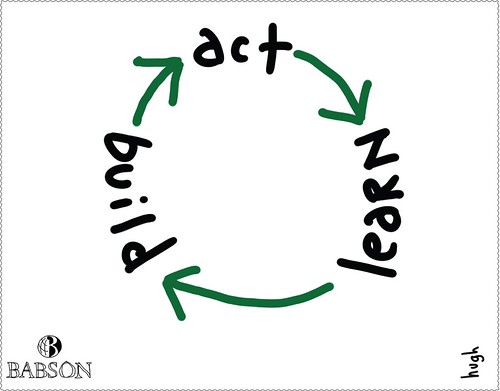 What do you call people who are experts at navigating extreme uncertainty while minimizing risk? Serial entrepreneurs is the correct answer according to the authors of Just Start: Take Action, Embrace Uncertainty, Create the Future (see previous post for complete citation). Serial entrepreneurs don’t start with a predetermined goal in mind. Rather, they allow opportunities to emerge.
 Nike’s “Just Do It!” may go down in business books as one of the most successful corporate slogans of all times. Americans in particular seem intuitively to understand the simplicity and common sense behind this concise call to action. So why do so many companies have difficulty launching new ventures? Why do so many organizations bog down in “analysis paralysis,” leaving potential moneymaking new revenue ideas behind in the process?
 Remember former New York Mayor Ed Koch, who was fond of asking, “How’m I doin?! While Koch was more brazen than the typical modest Minnesotan, his need to know if he was measuring up to expectations is fairly universal. In the study of thriving workplaces that I’ve been writing about in this series on happy employees, offering performance feedback was identified as one of the four most important things managers should do.