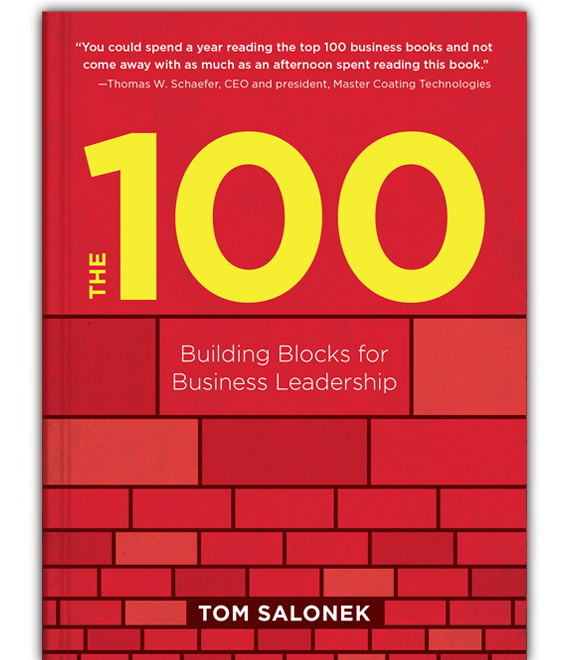
100
Building Blocks
100
Takeaways
34
Downloads
168
Pages
100 practical ways to improve your business, your team, and your life. Supported by over 30 tools and templates.
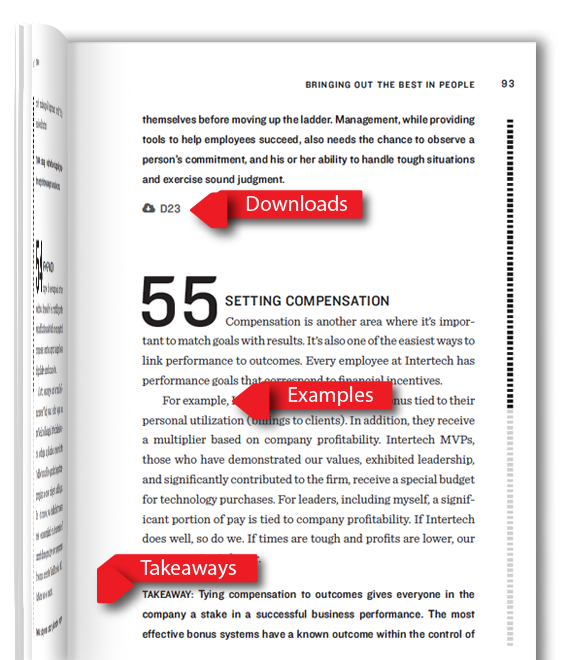
Downloads support implementation, examples illustrate ideas, takeaways summarize each section
100
Building Blocks
100
Takeaways
34
Downloads
168
Pages
Building Blocks for Business Leadership
Salonek believes that your business should “give life, not take it,” a philosophy that has helped him grow his own venture every year since its inception in 1991. In The 100, Salonek shares his secrets to business success in the form of 100 concise, nuts-and-bolts lessons for achieving the ideal work-life balance for maximum success.
Whether you own your own business or are simply thinking of starting one, this book will help you inspire teamwork, meet client expectations, clarify your personal values, and create a company culture to match. In addition, readers will gain access to a plethora of downloadable online resources—checklists, worksheets, templates, and more—to help implement the book’s ideas.
The 100 is a handy, inspiring addition to any business manager’s library.
what you will learn from this book
Each chapter contains clear, to-the-point sections that share practical and implementable ideas to improve your organization and your life.
The purpose of a successful business is to give life, not take it. Understand how to define and create your best future.
Engagement results in more profit and fewer hassles. Use this chapter to create it in your organization.
A world-class team starts with hiring. Find out field proven practices for hiring and on-boarding new talent.
Discover the key elements required to effectively lead others and how to handle a bad fit.
Use these tools, templates, and guidelines to state your business plan—from mission to 90 day goals—in one page.
Learn the five core elements for creating a high performance team.
Identify vendors and consultants who’ll go the extra mile and learn how to effectively manage the relationship.
With a series of Agile tools and best practices for leading people and projects, see how to over-deliver, on-time.
Discover the seven things all great leaders do and behavioral science backed communication strategies.
Find out how to use well scheduled and managed meetings to make them a freeing, not stifling, way to run an organization.
Problems are a sign that you and your organization are alive! Learn the best way to deal with issues.
“Not everyone can do great things,” but we all can “do small things with great love.” Make the organization bigger than itself.
Learn how to best use the 30+ downloadable tools to make The 100 have a huge impact on your firm and your life.
—David Reiling, CEO, Sunrise Banks

Tom delivers a keynote at an industry conference. Request Tom to talk at your conference or company.
Read parts of The 100
Easy to understand Downloads, Examples, and Takeaways that help you build and run a successful company that keeps your employees and family first!

INTRODUCTION
NOTE ABOUT ONLINE RESOURCES
CHAPTER 1: LIVING YOUR BEST LIFE
CHAPTER 2: USING EMPLOYEE ENGAGEMENT TO
OUTPERFORM COMPETITORS
CHAPTER 3: HIRING: THE FIRST STEP TO BUILDING A HIGH-PERFORMANCE TEAM
CHAPTER 4: LEADING AND GROWING TEAM MEMBERS
CHAPTER 5: OUTSMARTING AND OUTPLANNING THE COMPETITION WITH STRATEGY
CHAPTER 6: BRINGING OUT THE BEST IN PEOPLE
CHAPTER 7: GETTING THE MOST OUT OF OUTSIDE VENDORS AND CONSULTANTS
CHAPTER 8: MAKING PROJECTS SUCCEED
CHAPTER 9: LEADING OTHERS EFFECTIVELY
CHAPTER 10: MAKING MEETINGS WORK
CHAPTER 11: DEALING EFFECTIVELY WITH PROBLEMS
CHAPTER 12: GIVING BACK
CHAPTER 13: PUTTING IT ALL TOGETHER AND IMPLEMENTING THE IDEAS IN THIS BOOK
BIBLIOGRAPHY
ABOUT INTERTECH
ABOUT THE AUTHOR
The art of living lies in a fine mingling of letting go and holding on.
—HAVELOCK ELLIS, AFFIRMATIONS
The 100 has been in the making since I founded my company, Intertech, in my basement in 1991. I don’t mean that I’ve been actively writing the manuscript all this time, but I have been learning—both formally and through experience—about what it takes to run a successful business. Some of the ideas I once held have been abandoned after experience taught me a better way. Other strategies have been strengthened and honed based on invaluable feedback from my partners, advisors, and employees. I’ve also learned valuable lessons from graduate-level classes and from the esteemed professors and fellow entrepreneurs I’ve met through executive education programs at the Harvard Business School, the Massachusetts Institute of Technology, and the University of Minnesota’s Carlson School of Management.
This book is practical and is meant for anyone leading a team or business. I’ve included lots of hands-on techniques, tips, and management strategies. The book also reflects my personal vision and values, both of which are essential to how Intertech operates. Again, let me be clear: I’m not saying my way is the only way; I’m simply saying that every business must be grounded in a clear vision and compelling values to truly build employee engagement, and, ultimately, success.
I’m certainly not a Stephen Covey or a Peter Drucker, but I have seen firsthand how effectively these strategies work at Intertech. Intertech has received more than 50 awards: for being one of the fastest-growing firms in America; for being one of the best places to work according to the Star Tribune, Minnesota Business magazine, and the Minneapolis/St. Paul Business Journal; and for excellence in our management practices. But the real proof of our success is that Intertech has an abundant roster of highly satisfied repeat clients, great employees, and a consistently profitable bottom line.
As an entrepreneur operating a successful IT development and training company, my experience includes work with many different employees and Fortune 500 companies, governmental agencies, nonprofits, and a good number of small- to medium-sized firms. In thinking about this book, I realized that despite their differences, all these organizations (including my own) are facing the same profound challenges.
The Internet of Things promises to transform (and is already transforming) every aspect of business and customer expectations. The global village predicted by Marshall McLuhan in Understanding Media grows smaller with each passing day, while social media makes it easier for a single unhappy customer to do extensive damage to your brand reputation.
On the employee side of the equation, things also are changing rapidly. Millennials are motivated much differently than employees of the past. Research says they will change jobs almost three times more than their baby boomer coworkers, are not interested in long-term employment, and are as equally committed to their work as to their employer (Lyons, 2012).
What does all of this mean?
Things are changing! The upcoming workforce is a generation unlike any other and will transform how we attract and retain talent. Our competition can come as readily from Bangalore as from our backyard. And a frequently uncertain economy makes forecasting and growth challenging, at best.
Ironically, I believe all these changes are good in the long term. They force us to get better at serving our customers and employers, cultivating our employees (and ourselves), and understanding our markets. In essence, they compel us to build the strongest organizations possible to compete in the largely uncharted business waters of the 21st century.
In The World Is Flat, Thomas Friedman noted that to compete in the future, “We have to do things differently. We are going to have to sort out what to keep, what to discard, what to adapt, where to redouble our efforts, and where to intensify our focus.”
I hope this book helps you to do just that.
The 100 makes reference to more than 30 online resources to help you implement the book’s ideas. Lessons that correspond with one of these resources are noted with this symbol: 
All resources are available for download.
Wharton professor of management Adam Grant has researched and written extensively about teamwork. In his book, Give and Take: Why Helping Others Drives Our Success, he says that “organizations have a strong interest in fostering giving behavior.” I believe this is spot-on. “A willingness to help others achieve their goals lies at the heart of effective collaboration,
innovation, quality improvement, and service excellence. In workplaces where such behavior becomes the norm, the benefits multiply quickly,” he also notes.
Intertech consultants truly embrace the “one team, one dream” philosophy, and our company continues to grow and thrive as a result. We do not tolerate ego-inflated superstars who think only of themselves, to the detriment of customers or fellow consultants. We only hire professionals who understand the value of pulling together, like crew members of a rowing team, with corresponding positive results.
Of course, sometimes consultants need to focus on a particular project or deadline and are not readily available to give assistance when asked. We encourage our consultants to consider the feelings of their colleagues in these situations and to share why they are not available. A statement like, “I would like to help you, but my customer is expecting my project tomorrow. I don’t want to disappoint him,” is a lot better for team morale than, “Are you kidding? I don’t have time to help you!”
TAKEAWAY: It’s easy to stop one guy, but it’s pretty hard to stop 100.
—JACK STACK, THE GREAT GAME OF BUSINESS
Tom Salonek founded Intertech, Inc. in 1991, growing it from a one-person shop to the largest combined software developer training company and research-supported consulting firm in Minnesota. Intertech has been featured in stories in Fortune Small Business, Forbes, The Business Journal, Twin Cities Business, Upsize, Ventures, Star Tribune, Pioneer Press, and Inc. Intertech has won over 50 awards, which includes being named one of the 30 Best Places to Work in Tech by Fortune magazine.